
Your pipe burst on a Sunday. You cleaned up the visible water, threw down some towels, and figured you’d deal with it properly on Monday. By Tuesday morning, there’s a musty smell coming from behind the drywall that wasn’t there before.
That smell isn’t a coincidence. It’s mold, and it moved faster than most homeowners expect.
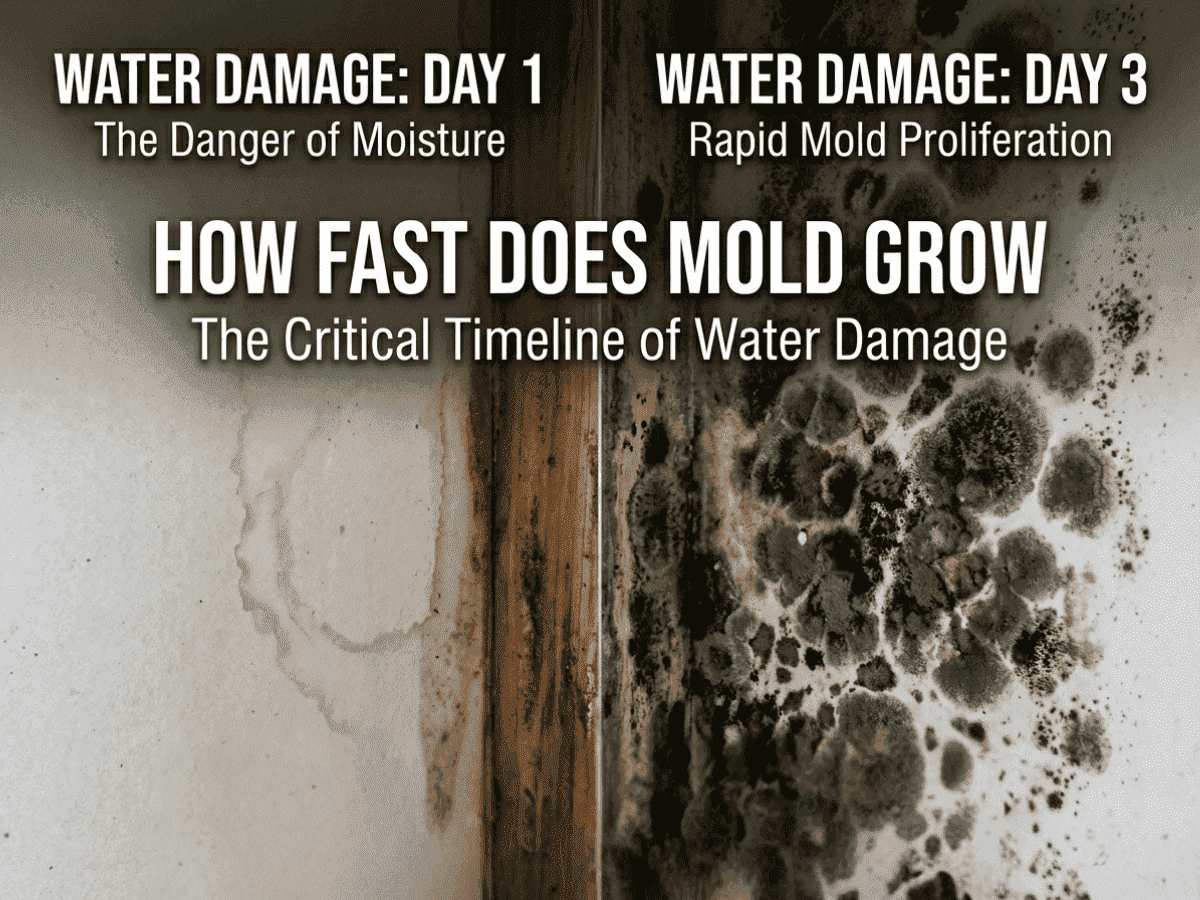
So, how fast does mold grow after water damage? The answer most people have heard is 24 to 48 hours. That’s accurate as a baseline, but it’s a national average built around “standard” indoor conditions. In Georgia, where summer humidity routinely sits between 70 and 80 percent, mold doesn’t wait politely for the 48-hour mark. This article breaks down the exact growth timeline, explains why Georgia’s climate compresses it, and tells you what to do in the hours that actually matter.
What Mold Actually Needs to Start Growing
Mold isn’t mysterious. It’s opportunistic. Four conditions must align for mold spores to activate and begin colonizing a surface: moisture, an organic food source (drywall paper, wood framing, carpet fibers), warmth, and limited airflow. Take away any one of those four, and mold struggles to establish itself. Give it all four at once, and you’re on a clock.
Here’s the part most people miss: mold spores are already in your home. They’re in the air right now, completely dormant. The moment water saturates a porous material, those spores absorb the moisture and begin to germinate. They don’t need to travel from somewhere else. They’re already there, waiting.
The IICRC S520 Standard for Professional Mold Remediation, the industry benchmark that certified remediators follow, identifies mold colonization as beginning within 24 to 48 hours under standard indoor conditions. The critical variable the standard points to is relative humidity (RH). Above 60% RH, mold growth accelerates significantly. Below 50% RH, growth slows substantially. In a home without functioning air conditioning,
Georgia’s average indoor relative humidity during the summer months ranges from 70 to 80 percent, according to NOAA climate data. That means Georgia homes aren’t operating anywhere near the “standard conditions” the national 48-hour window assumes. The margin is gone before the damage even happens.
Mold Growth Timeline After Water Damage
This is the do-nothing scenario: what happens to a water-damaged material in Georgia if no drying or treatment begins? Understanding this timeline is the clearest argument for acting immediately.
| Timeframe | What’s Happening |
| 0 to 12 hours | Water saturates porous materials. Drywall, subfloor, and insulation begin absorbing moisture. Dormant spores start hydrating. |
| 12 to 24 hours | Spore germination begins. Hyphal threads begin forming on wet surfaces, though nothing is visible. |
| 24 to 48 hours | Visible mold colonies can appear. A musty odor often develops. This is the window most national sources cite as the mold threshold. |
| 48 to 72 hours | Colonies spread to adjacent materials. Some mold species begin mycotoxin production at this stage. |
| 72 hours to 1 week | Structural materials are compromised. Remediation scope expands significantly, often requiring drywall removal and subfloor replacement. |
| 1 week and beyond | Deep contamination behind walls, potential HVAC infiltration, and air quality concerns throughout the structure. |
The -0 to 12-hour window is deceptively quiet. Nothing looks wrong. But inside wet drywall or underneath soaked carpet padding, the process has already started. Spores that have been dormant for months are activating.
Between 12 and 24 hours, germination is underway. This is the stage most homeowners never know is happening because there are no visible signs. The mold behind drywall timeline begins here, not at 48 hours.
In 24 to 48 hours, you might notice a smell before you see anything. That earthy, musty odor is a byproduct of mold metabolism. If you’re detecting it, colonization is already in progress.
From 48 to 72 hours onward, the damage compounds rapidly. Mold that starts on one wall panel begins to spread into the adjacent framing. Some species produce mycotoxins, which create indoor air quality concerns beyond the structural damage itself.
Mold 24 hours after a leak isn’t just possible in Georgia. Likely, the materials weren’t dried immediately.
Why Georgia’s Climate Accelerates the Mold Timeline
Georgia averages 50 to 55 days per year with temperatures at or above 90 degrees Fahrenheit, and summer humidity rarely drops 70 percent below outdoors. That combination is essentially a mold incubator.
The part that catches homeowners off guard is what happens after the visible water is gone. You mop up the puddle, pull the wet towels out, and assume the hard part is over. But the moisture that soaked into your drywall, subfloor, and wall insulation doesn’t evaporate quickly in Georgia’s ambient air. When outdoor humidity is 75 percent, your indoor air is constantly working to equalize with that level. Every time someone opens a door or window during cleanup, they’re potentially reintroducing moisture into materials that were just starting to dry.
Atlanta receives an average of 51 inches of rainfall per year, compared to the national average of 38 inches. That’s not just more rain events; it’s a baseline soil and air saturation that makes Georgia homes structurally more vulnerable to moisture intrusion. Crawl spaces, which are common in older Georgia construction, pull ground moisture upward through vapor. Wood-framed walls with fiber insulation hold water longer than more modern materials. Slab foundations in newer construction can trap moisture beneath the flooring with no drainage path.
Mold spores and humidity in Georgia aren’t an abstract concern. They’re a specific, measurable risk that shortens the national 48-hour timeline for a significant percentage of Georgia homeowners. In practical terms, a leak that might give a Minnesota homeowner 36 hours before colonization might give a Georgia homeowner in July 18 to 20 hours under the same material conditions.
How to Know Mold Is Growing Before You Can See It
By the time mold is visible, it’s been growing for a while. Knowing the early warning signs gives you a better chance of catching it in a stage where remediation is still straightforward.
A musty or earthy odor is typically the first indicator. Mold produces volatile organic compounds (VOCs) as part of its metabolism, and that smell often appears before any visible growth. If your home smells different after a water event, trust that instinct.
Discoloration on walls or ceilings usually shows up next. Early colonies often appear as small grey, green, or black spots that can be mistaken for dirt or shadows. Check corners and areas near baseboards closely.
Warping or bubbling drywall indicates moisture is trapped behind the surface. The paper facing of drywall is essentially food for mold, and when it’s saturated, colonies can develop on the back face without any exterior indication.
Allergy-like symptoms in occupants, particularly sneezing, eye irritation, or worsening asthma, can signal elevated mold spore counts in the air. This is especially telling if the symptoms correlate with time spent in specific rooms.
Soft or spongy flooring suggests the subfloor beneath has absorbed water. Mold between a finished floor and its subfloor is common and difficult to detect without professional moisture testing.
Condensation forming on windows after a water event indicates elevated indoor humidity. That same humidity is present inside your walls.
The difficult reality with mold behind drywall is that you can have extensive colonization without any of these surface signs. By the time the smell or discoloration appears, the remediation scope is already larger than it would have been had testing been done at 24 hours.
IICRC Standards for Responding to Water Damage
The IICRC doesn’t just have guidelines for mold; it also publishes the S500 Standard for Professional Water Damage Restoration, which governs how water damage should be addressed. Understanding both together is important.
The S500 classifies water damage by two dimensions. The first is the contamination category:
- Category 1 is clean water from a supply line or rainfall with no contamination
- Category 2 is gray water with some contamination, such as dishwasher overflow
- Category 3 is black water, including sewage backups and floodwater, which carries pathogens
The second dimension is water class, rated 1 through 4, based on the amount of water present and how quickly it will evaporate from the affected materials.
The IICRC standard recommends professional drying equipment be deployed within 24 hours of a water event to prevent mold colonization. The specific moisture thresholds the standard sets are clear: wood materials must reach below 19% moisture content, and drywall must reach below 1% moisture content before walls can be closed or surfaces refinished.
A household box fan and a rented dehumidifier don’t come close to achieving those thresholds in Georgia’s ambient humidity. Professional-grade desiccant dehumidifiers and axial air movers are calibrated to work against the surrounding air conditions, not alongside them. In a Georgia summer, that distinction determines whether you’re completing a drying job or just moving humid air around.
If your home has experienced water damage, the water damage restoration process should use equipment and protocols aligned with the IICRC S500, rather than general household drying methods.
Your 24-Hour Mold Prevention Checklist After Water Damage
The first 24 hours after water damage are the highest-leverage period you have. Here’s what matters most, in order of priority.
- Stop the water source first. Shut off the supply valve to stop a pipe leak, or contact a plumber immediately if the valve isn’t accessible. Nothing else matters until the water stops.
- Remove standing water as fast as possible. Wet-vac or mop everything you can reach. Do not let standing water sit overnight under any circumstances.
- Pull up wet carpet and padding. Carpet padding, in particular, acts like a sponge and cannot be effectively dried in place in Georgia’s humidity. Once it’s saturated, it needs to come out.
- Be strategic about windows. Opening windows feels like the right move, but only if the outdoor relative humidity is below 60%. If it’s a Georgia summer day and the humidity outside is 78%, you’re making the interior worse, not better.
- Run your AC on its lowest setting. Air conditioning simultaneously lowers the temperature and removes humidity from indoor air. It’s one of the most effective tools you have in the first hours.
- Document everything before you touch it. Take photos and video of all affected areas for your insurance claim. Adjusters want to see the condition before.
- Contact an IICRC-certified water damage restoration company. For any water event that affected drywall, flooring, or insulation, professional moisture testing and drying equipment are not optional if you want to prevent mold. Check for 24-hour emergency response availability.
- Do not paint over or seal wet walls. This traps moisture inside the wall cavity and dramatically accelerates the growth of hidden mold. It also complicates insurance claims and future remediation.
Every hour matters in a way that has real dollar implications. The difference between a $1,500 professional drying job and a $15,000 mold remediation is often just 48 hours of inaction.
Frequently Asked Questions
1. Can mold grow in 24 hours?
Yes. When moisture, warmth, and relative humidity above 60% are present, mold spores can begin to germinate within 24 hours of water exposure. In Georgia’s climate, especially during summer months when indoor humidity without air conditioning reaches 70 to 80 percent, this timeline is regularly shorter rather than longer. The IICRC S520 acknowledges 24 hours as the lower threshold for colonization under favorable mold conditions.
2. How quickly does mold develop behind drywall?
Mold can begin colonizing the back face of drywall within 24 to 48 hours of saturation. Because drywall paper is an organic food source and the cavity behind it has poor airflow, this combination creates near-ideal conditions for mold growth. The hidden location means it typically goes undetected for 72 hours or more, at which point remediation requires drywall removal rather than surface treatment.
3. Can I stay in my home after water damage?
It depends on the extent of the damage and how long water has been present. If water has been sitting untreated for more than 24 hours and has affected significant wall or floor areas, air quality testing is recommended before continued occupancy, particularly for households with children, elderly occupants, or anyone with respiratory conditions.
4. Does insurance cover mold from water damage?
Standard homeowners insurance typically covers mold resulting from a sudden, covered water event, such as a burst pipe or appliance failure. It generally does not cover mold resulting from long-term neglect or gradual leaks. For more details on navigating this process, see our guide on whether insurance covers mold after water damage.
Act Before the Smell Starts
The 2-4 to 48-hour mold window is real, and it’s backed by IICRC standards that certified remediators follow industry-wide. But those standards were built around baseline indoor conditions that Georgia routinely exceeds from May through September. In practice, Georgia homeowners operating in summer humidity face a compressed timeline and a building stock (wood framing, crawl spaces, fiber insulation) that retains moisture longer than the national average.
None of that is a reason to panic. It is a reason to act fast and call people who know what the IICRC drying standards actually require.
If your home or business in the Marietta, Atlanta, or surrounding Georgia area has experienced water damage in the last 24 to 72 hours, don’t wait for the smell to confirm what’s already happening. Contact Relief Remediation for an assessment. We’re IICRC-certified, we serve the greater Atlanta area, and we offer free inspections for recent water damage events. The call costs nothing. The wait might.